The Coding ‘Trust Paradox’: Why Developers Rely on AI They Doubt
Developers find themselves caught in a fascinating dilemma—a so-called "trust paradox"—when using AI tools in their coding processes. 🤔 Released on September 23, Google's DORA 2025 report reveals that while developers appreciate the usefulness of AI-generated outputs, they remain hesitant to fully trust these tools.
🤖 AI: A Supportive Ally, Not a Replacement
The report highlights a critical shift in how developers view AI. Rather than seeing it as a full-fledged replacement for human judgment, they view AI as a powerful supportive tool that enhances workflows, refines productivity, and boosts efficiency—all while ensuring developers retain ultimate control. Isn't that comforting?
Speaking of comms, remember Andrej Karpathy? Former Tesla AI director and all-around AI bigwig, he famously dubbed English the “hottest programming language.” Why? Because now, instead of wrestling with copious lines of code, developers can simply describe what they want in plain English, and voilà! Large Language Models (LLMs) do the heavy lifting. 🪄
📈 Vibe Coding: The Next Revolution
This brings us to an exciting development in programming: vibe coding. Vibe coding takes flexibility to a new level, evolving beyond no-code and low-code platforms like Bubble and FlutterFlow, which allow non-techies to drag and drop elements but limit customization potential.
In vibe coding, developers can provide a simple prompt—say, “Build a React weather app showing temperature and humidity.” The AI generates an entire project with API integration, granting developers an unprecedented level of creative freedom. Need to tweak it? Just say “Add voice search!” or “Change the background according to the weather.” Even debugging becomes a breeze; instead of staring at error logs like a lost puppy, a developer can request, “Fix this Python script so it runs 30% faster without errors.” 🐶💻
🛠️ The Trust Issue: Are AI-Generated Codes Reliable?
While the call to embrace AI-assisted coding is loud and clear, questions still loom large: Is the code reliable if generated by AI without supervision? DORA's report underscores this concern, urging developers to adopt a “trust but verify” approach when harnessing AI tools. This attitude reflects a mature, responsible engagement with AI in the workspace.
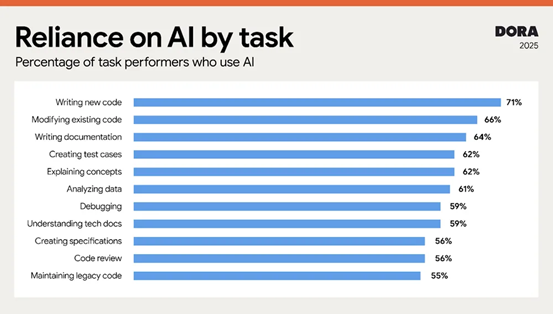
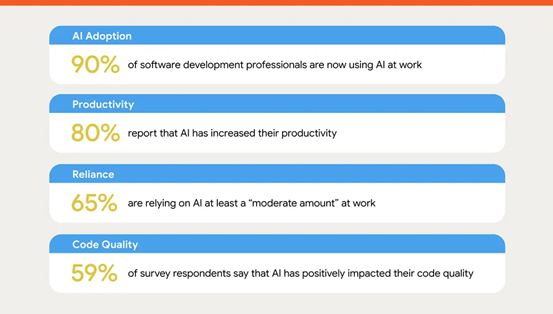
According to the report, AI adoption among software professionals has skyrocketed to 90%—that's a hefty rise of 14% from last year! 🆙 Daily interactions with AI have become commonplace, with developers typically spending around two hours a day utilizing these powerful tools. That’s some serious bonding time!
💡 The Upside: Increased Productivity and Code Quality
So, what's the bottom line? Benefits abound! An impressive 80% of developers assert that AI has significantly enhanced their productivity, while 59% attribute improved code quality to these high-tech helpers. Can you say game-changer? 🎉
🎯 Setting the Blueprint for AI Integration
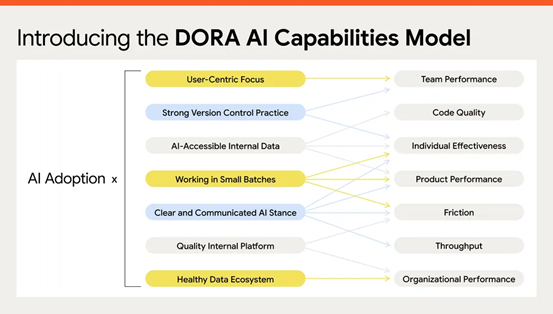
Google has thoughtfully introduced the DORA AI Capabilities Model, outlining seven capabilities designed to enhance the impact of AI in software development. Key aspects include drafting a clear AI policy, fostering a healthy data ecosystem, and ensuring user-centric development practices. 📝🚀
In conclusion, the relationship between developers and AI is a dance—a precarious yet necessary tango that marries human creativity with machine efficiency. As the field evolves, organizations must adapt their cultures and processes to realize the full potential of AI in software development. Are you ready to join the dance? 🎶